What Penny is · 1 October 2026
A bookkeeping agent between a company’s banks, cards, bills, and QuickBooks.
It does the repetitive first pass of a monthly close — collect the money movements, code them the way that company was coded last month, and hand a person only the lines it cannot settle — and it answers plain questions about the books. Nothing is posted to QuickBooks until someone says so.
The audience it is built for is an operator who closes books for clients, a fractional CFO or a bookkeeping firm. The judgment and the client relationship stay with them. Two companies have been the proving ground: one for the close-coding experiment, and one for the live cash work.
The console also has a second tenant, for showing the product without a client’s books. An ordinary user is attached to one company. An admin sees both. That cash page reads a fictional company, Alderwood Systems, and has no bank integrations. The live client’s pulls are unchanged.
The zero-day close
Books coded as the month happens, not after it ends.
Close on day zero, not day six.
Drag the playhead to scrub · autoplays otherwise
What it does
Three jobs, at different stages of maturity.
- 01
Code the month
Take a bank statement and vendor bills, and assign each line a treatment: an expense with a vendor and a P&L account, a bill being paid, money moving between the company’s own accounts, or “a person needs to look at this.”
0%On one July 2026 close, rules mined from the prior six months auto-coded about 97% of bank lines the same way the real close did. The rest landed in a review queue. That flow exists as a finished simulation in the web console — worklist, bills, reports next to QuickBooks’ own numbers, an editable rulebook — and it can be written into a practice QuickBooks company and erased again. It is not yet the daily product on a live client.
- 02
Show the cash, without waiting for the close
For one client this is live. Banks (via Plaid), card cash, and the bills database feed a cash-flow page — who paid us, where it went, balances by account — and a 13-week forecast with base, downside, and upside, a minimum-cash line, and a backtest of how the same engine would have done four weeks ago. It refreshes every weekday morning and replaces the manual weekly cash audit for the bank half of that report. One bank is connected and is not yet in the totals. Some large card bill-pay lines still hide the real payee.
- 03
Talk to the books
In Slack, and in the same chat in the console, you can ask read-only questions — cash balance, does this vendor exist — or drop an invoice with an instruction (“file this to LinkedIn, it’s already paid”). Penny proposes the QuickBooks entry and writes it, with the document attached, only after someone replies confirm.
Underneath those, there is a quieter capability: copying a mature company’s chart of accounts, vendors, opening balances, and history into an empty practice company, so a close can be rehearsed without touching the real books.
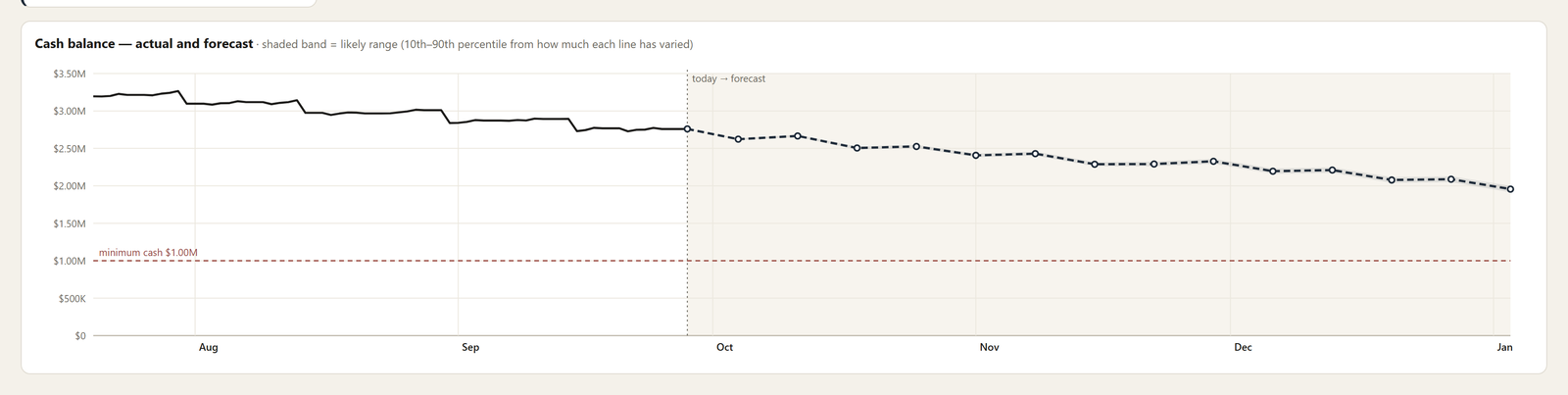
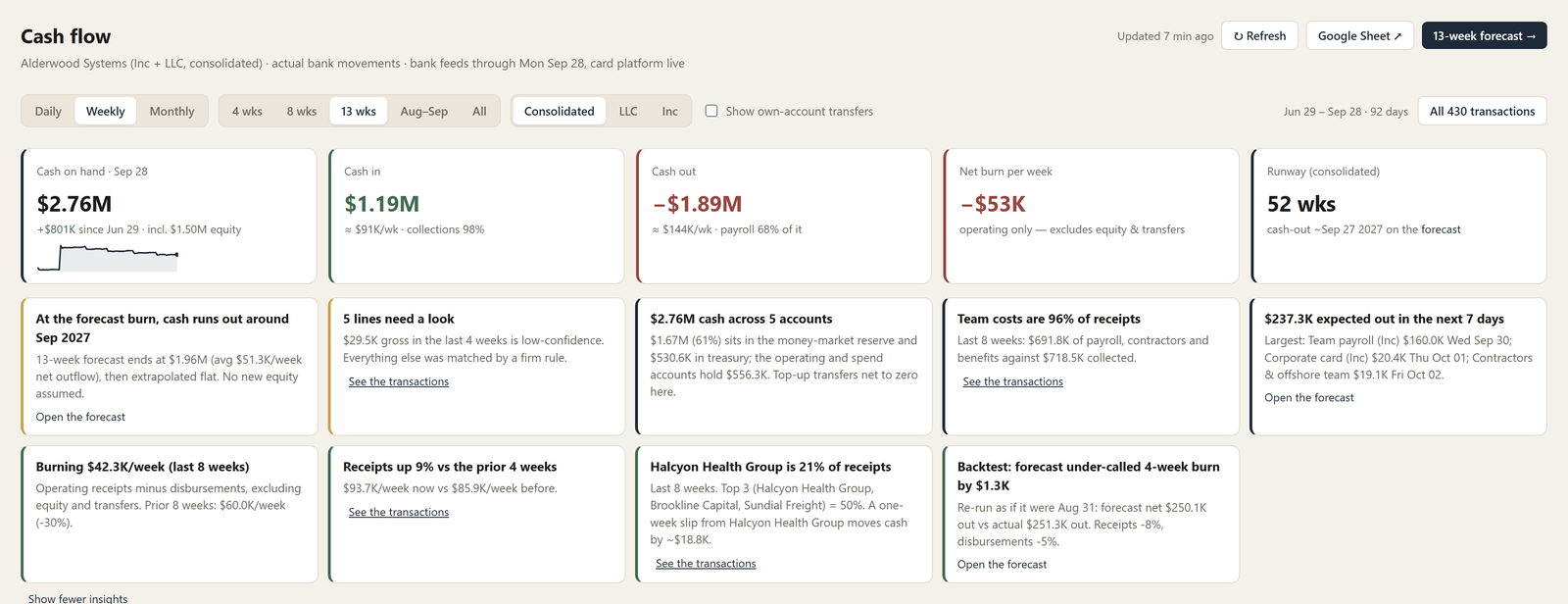
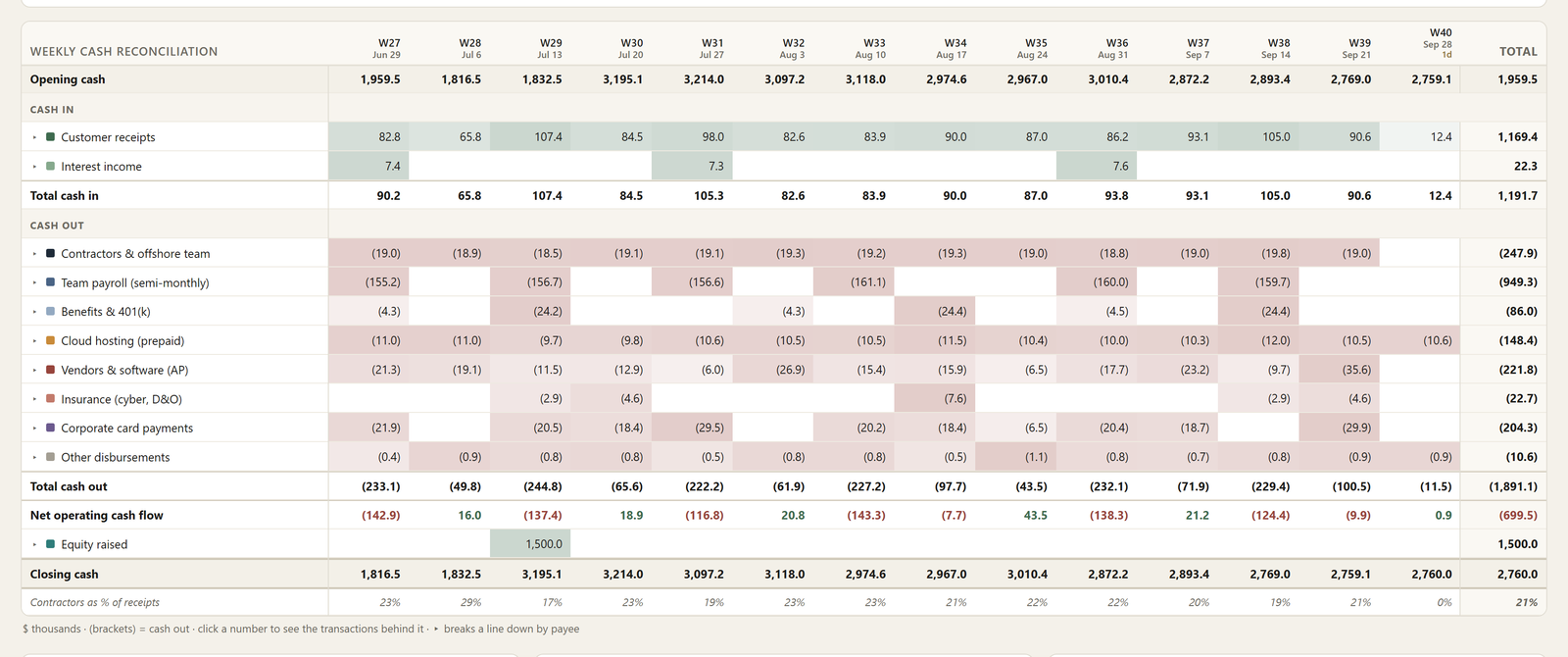
A forecast drawn from the bank, with a minimum-cash line.
Alderwood Systems, a fictional company used to show the console. Not a client.
Why it matters
Month-end is mostly collecting statements, chasing bills, and coding the same vendors as last month. That work scales with clients and headcount, and it crowds out the advisory work a fractional CFO actually sells. Penny’s bet is that a client’s own history is a good enough teacher: most lines repeat, so a rulebook built from that history can clear them, and a person spends the close on exceptions and judgment. The cash pages are the other half of the same idea — a controller can see burn and the next quarter of cash on day one, instead of after the books are closed.
The control story is the part firms ask about first. Each client has its own rulebook, written so a person can read and edit it, and a correction can become a new rule. Posting to QuickBooks is a separate, explicit step.
Integrations
Penny connects the sources a close already depends on into one console, with a company switcher so staff can move between clients. Customer-facing channels, a Slack bot and a mailbox, are meant to stay isolated per company, so one client’s books never sit in the same running process as another’s.
- QuickBooksThe books. Penny proposes the entry and writes it only after confirm.
- Banks, via PlaidOne bank feeds the cash page. Another is connected and not yet in the totals.
- BrexCard and cash feeds. Some large bill-pay lines still hide the real payee.
- BillsMailbox or Drive in, matched to vendor history and the statement.
- SlackSame chat as the console. Questions are read-only; filings wait for confirm.
Coding is mostly deterministic. Prior months are mined into plain rules (“this bank text means this vendor and this account”). A new statement is run through them. Lines with no rule go to review, where a person decides, or asks Penny for a suggestion with the reasoning shown.
Cash works the same way, one level up. Every movement is classified — collections, payroll, transfers, and so on. Own-account transfers are paired so they do not look like income or spend. The forecast is a stack of simple drivers: recent run-rate for customers who pay steadily, detected cadence for bills that recur, and a residual for the rest. A person can turn a line off, drop in a one-off (a raise, a large payment), and see the cash-out date move.
The model is used where rules stop: suggesting a treatment for a review line, and answering questions about the ledger. The question path has no way to write to QuickBooks.
Where the picture is still uneven
Updated 1 October 2026
- Day-one close
The day-one close is demonstrated on one company’s July, inside a practice company. A second company’s equivalent was studied and is not built. Most of that spend arrives through Brex, which already names the merchant, so “read the bank text” rules barely apply. Trusting Brex’s vendor and learning vendor-to-account gets to roughly 60% of lines. The rest need a controller’s answers: how to split a few vendors, and how Class and Location should be allocated.
- What’s live today
Cash is the part a controller can open today. The same cash screen, filled with the fictional Alderwood books, is what the demo tenant shows. The close worklist is the part that shows the coding product, and those screens are currently switched off in the console.
- Left out on purpose
Payroll and revenue were left out of that close on purpose. The forecast still cannot see billed revenue, and a few large bill-pay vendors stay unnamed until a better Brex or Bill.com feed exists.